
- News
- City News
- bengaluru News
- The politician as puzzle
Trending
This story is from December 9, 2018
The politician as puzzle
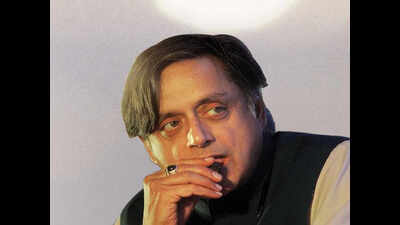
The crowd has more women than men in it.

And when the ribbon is cut, Tharoor walks around the gallery, admiring some paintings and commenting on the usual anonymity of folk artists. He pauses in front of a picture of Nandi, and points to a crescent moon and says “That’s where I get my name from. Shashi”.
“What about the Congress?” The reading itself is unremarkable, and Tharoor examines the marketing of Modi to an aspirational India. But when the reading is done, he faces a battery of questions from a crowd where a significant number believe in Modi’s capabilities and intentions. He answers patiently. The book is an evaluation of Prime Minister Modi’s results, against his promises prior to 2014, he points out. Not an examination of what came before. “But what about the Congress?” he is asked. Tharoor then talks about his criticism of both the riots of 1984 and Operation Bluestar, the politicization of gubernatorial appointments, and refers frequently to his 1997 book, India: From Midnight to the Millennium and Beyond.
It’s a plausible argument, but Tharoor is careful not to say very much about issues within the party today – though he does take a few jabs at overanxious party apparatchiks and their reactions to his remarks about a Hindu Pakistan – which led to the inevitable war of words on Twitter.
Statues and scions
The conversation turns to Sardar Patel, and Tharoor begins by praising his importance to the freedom struggle and the unification of India, and then unmasks his batteries and takes aim at the Statue of Unity. “I think it’s a pretty hideous idea. Because, why would anybody make a repeat visit? I can imagine enough of us, driven by curiosity, going there once, but when you take the elevator to the terrace around his chest, and you look around and all you see are barren fields and dry land. I have a feeling that the logic that tourism would pay back the cost of constructing it is mathematically unviable,” he says.
The conversation returns to Rahul Gandhi’s leadership of the Congress party and the possibility of a Tharoor as a possible Prime Minister. Tharoor begins his response with calculated candour, noting that every political party is ruled by factions - and then, as the audience waits for juicy gossip about the factions within the Congress - goes on to say that if free and fair elections were held within the Congress, Rahul Gandhi would win hands down. From there, he hypothesizes that if the BJP were to return with a diminished majority, they may have to present another candidate as Prime Minister who may be acceptable to prospective coalition partners - which would, in turn, affect those who vote for the BJP purely because of Mr Modi.
Blyton and Biggles
It’s hard to imagine the self -assured politician as an asthmatic little boy living in the imaginary village of Enid Blyton’s St Peterswood or flying the fictional skies with Capt WE Johns’ Biggles and Ginger, but at the age of twelve, Tharoor wrote a story called Operation Bellows. It’s lost now, he says. “A lot of my childhood manuscripts have been lost. I began writing when I was six years old, and many of those things were never even published. Before Operation Bellows was a thing called ‘Solvers on the Trail’ which was my Indianization of the Enid Blyton books. She had her Five Find-Outers and the Secret Seven, and I created the Six Solvers, and like me, who was dragged off to Kerala villages every year, these kids would get dragged off to Kerala villages and would solve mysteries there,” he says.
But it was these trips to Kerala villages where Tharoor learnt to speak Malayalam - “unsophisticated, colloquial, Palakkad-accented Malayalam”, something that stood him in good stead when he returned to India and took up politics.
And as he wraps up the session, and heads towards the hotel’s lunch buffet, one of the service staff comes up to him, shyly, and says a few words in Malayalam. They talk for a bit in the same language, and the staffer goes away with a huge grin on his face.
Celebrity woes
The waiter isn’t the only one. Tharoor is dogged by selfie seekers - young and old, men and women. He gives them all time, and poses patiently. “People don’t fully appreciate the extent of the loss of privacy that comes with being a public figure in a country like India. It doesn’t affect everyone, and I should consider myself, in some ways, fortunate, that when I’m on a plane with other politicians I’m the one who gets people coming and asking me for selfies. But in many ways, I would quite prefer to sit in my seat and read my newspaper. Sometimes you have people who are too shy to come up to you, send you notes saying how much they admire something you’ve written – and that is quite gratifying. But when simple pleasures are denied to you, it gets intrusive,” he says.
“I can’t go shopping, for example. It becomes awkward for everybody. Other shoppers want selfies. Your presence becomes a distraction,” he pauses. “You’re not able, like anybody else, to bargain,” he laughs.
The food arrives. Tharoor examines his bowl of tofu with suspicion. There’s not enough tofu, and too many vegetables. He tells an obsequious maître d’′ this, and the latter scurries off. By this time, more people have landed up, asking for selfies and photographs. One little old lady sits next to him, asking plaintively, “Shouldn’t we be giving Mr Modi more time?”
By this time, Tharoor has been speaking, almost non-stop, for four hours. He’s handled every kind of question – from the coy and the flattering to the outright hostile. But he’s remained even tempered, good natured, and has responded with unfailing politeness. And you get the feeling, as he answers every question, that Tharoor has done this before, time and time again. There are no new questions for him – at least there haven’t been for a long time. And at this point, you can’t help contrasting him with other politicians who interact with questioners – across every political persuasion - who need strictly controlled conditions and severely defined boundaries, and mark the difference.
On Sabarimala
“When the judgment came, I did welcome it. But what I realized from the backlash that resulted, resentment against the court verdict among ordinary people, people I could meet and talk to in my own constituency and elsewhere in Kerala, was that the issue had been misframed. The argument was that Kerala women aren't going around feeling unequal. They have said that this isn't a decision we had asked for. There was never any mass movement of women saying that they had been denied access to Sabarimala. This was very much a fringe request. There is nothing particularly rational about religion. Religion is about worship and faith and belief, and very often, rationality doesn't come in. The myths that led to one gender being barred from some temples may be dismissed by rationalists - but so can the Virgin Birth or the Archangel Gabriel coming down with the word of God to the Prophet. Where are you going to draw the line by saying that rationality must apply to every religious belief?”
On the nature of his celebrity
“I can’t go shopping, for example. It becomes awkward for everybody. Other shoppers want selfies. Sometimes, the storekeeper wants a selfie. Your presence becomes a distraction to other shoppers.”
Watching an unusual politician deal with fans, and listening to him talk about the nature of celebrity, his party, and religion.
End of Article
FOLLOW US ON SOCIAL MEDIA










Photostories

Hot Picks
TOP TRENDING
Popular Categories
Hot on the Web
Top Trends
IND vs AUS Live ScoreBaba Siddique NewsVirat KohliRussell WilsonsSpacex StarshipRahul DravidWho was Baba SiddiqueBabar AzamNTA SWAYAM July RegistrationLawrence BishnoiAmazon LayoffsTaylor SwiftManagement Colleges of IndiaTop Medical Colleges of IndiaTop Engineering Colleges of IndiaTop Pharmacy Colleges of IndiaLive Cricket Score
Trending Topics
Diwali WishesDussehra 2024 QuotesDussehra WishesVettaiyan OTT ReleaseVettaiyan CollectionVettaiyan ReviewNatasa StankovicDevara CollectionBigg Boss 18Deepika PadukoneShraddha KapoorRatan Tata Passed AwayJigra Movie ReviewVettaiyan Movie ReviewSwatantrya Veer SavarkarDussehra 2024Star Health Hacker DemandedViral MemesUltimate Football Codes October 2024Wordle Answer
Living and entertainment
Latest News
Over 70 injured at Devaragattu Banni stick festival during Dussehra celebrationsPassion missing, players don’t want to work hard, lament former intl’sHow tomato, potato, onion influence food inflationBiker’s death ignites village fury in Odisha's Boudh, massive traffic jam on NH-57Reliance Jio sends 'complaint letter' to telecom minister Jyotiraditya ScindiaWomen's T20 World Cup: Why India need Pakistan victory over New Zealand to secure semifinal berthSpaceX's fifth Starship test flight achieves historic booster catchCops probing Bishnoi gang's links to Siddique's murderNews brief: 'Who is listening? Modi?': Kapil Sibal takes a dig at RSS chief Mohan BhagwatPapankusha Ekadashi 2024: Date, Parana Time, Puja Rituals and SignificanceKenya's Ruth Chepngetich breaks women's world record at Chicago MarathonAI’S OppenheimerBaba Siddique murder case: Slum dispute that sparked ED inquest to be part of probeFor 20 years, Thar getting more rain than normalSpiritual fervour marks Bagh Savari festival held at TirumalaBigg Boss Tamil 8: Ravindar Chandrasekaran gets evicted from the houseFPIs pull out Rs 59,000 crore from equity in OctoberPresident's rule revoked in J&K after almost 6 years, stage set for Omar Abdullah's government
Copyright © 2024 Bennett, Coleman & Co. Ltd. All rights reserved. For reprint rights: Times Syndication Service